

Content marketing means publishing useful posts, guides and videos that answer your customers’ questions. That way, people find you and trust you before they get in touch. For most small businesses, it starts with one helpful blog post a month. This guide covers what to publish, how it helps SEO and how to measure the results.
Key takeaways
- Answer the questions your customers already ask you.
- Publish on your own website first, then share it everywhere else.
- One useful post a month beats five rushed ones.
- Judge your content by enquiries and jobs, not likes.
What is content marketing?
It is marketing that helps first and sells second. Instead of an ad that says “hire us”, you share something useful. For example, a bakery might explain how far ahead to order a wedding cake. A roofer might explain the difference between a repair and a full replacement.
People read it, learn something and remember who helped. Then, when they are ready to buy, your business is easier to recall and easier to trust. Over time, the same posts also bring new visitors from Google.
Useful content is one part of a wider marketing plan. For the full picture, read our guide to what each online marketing channel does.
Why helpful content suits small businesses
First, it doesn’t need a big budget. A good post costs time rather than ad spend, and it keeps working after you publish it. By contrast, an ad stops the day you stop paying.
It also builds trust. People who have read your advice already know how you think and how you work. As a result, the first conversation is easier for both sides.
Best of all, you already have the raw material. The questions customers ask you every week are your topic list.
What to publish first: content types compared
Start with formats you can keep up. This table compares the common options, so you can pick one or two.
| Type | Good for | Effort |
|---|---|---|
| Blog posts and guides | Answering questions and showing up in Google | Medium |
| FAQ pages | Quick answers before people get in touch | Low |
| Social media posts | Showing followers you are active | Low |
| Email newsletters | Bringing past customers back | Low |
| Short videos | Showing a process or a finished job | Medium to high |
| Press releases | Sharing real news, such as a launch | Medium |
For most local firms, blog posts come first. They live on your site, Google can read them, and you can reuse each one in emails and social posts. If you have real news to share, a press release service can send it to media outlets.
That’s also why your best content should live on a website you own, not only on a social platform. For that, you need a domain name and hosting. Cyberduck Domains, a MagniTech sister company, sells domain names and WordPress hosting. If you don’t have a blog page yet, MagniTech’s website development packages show which builds include one.
How blog posts help your SEO
Search engine optimization (SEO) is how your pages earn unpaid places in Google. Each post you publish is a new page that can show up when someone searches a question. So a site with ten helpful answers has ten chances to be found, not one.
However, more pages only help if they are good. Google says its systems aim to reward content made to help people, not content made to rank. Its guide to creating helpful, people-first content lists questions you can use to check your own posts.
Posts also help your other pages. When a post links to a related service, readers find the next step. If writing isn’t your thing, MagniTech’s monthly SEO plans include written blog posts with internal links.
A simple monthly content plan
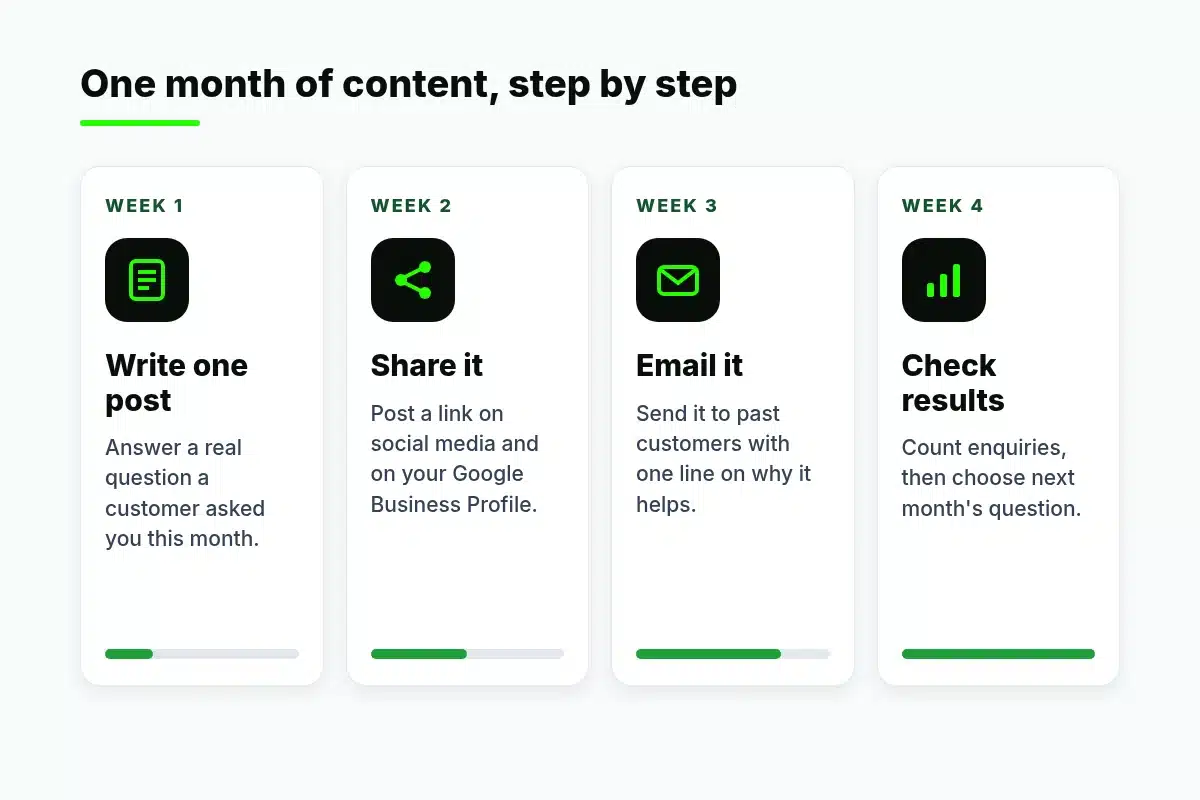
A steady rhythm matters more than volume. This four-step plan repeats every month:
- Week 1: Write one post. Answer a real question a customer asked you this month.
- Week 2: Share it. Post a link on your social media pages and on your Google Business Profile.
- Week 3: Email it. Send it to past customers with one line on why it helps.
- Week 4: Check the results. Count enquiries, then choose next month’s question.
Keep a running list of questions as they come up. Then you’ll never start the month with a blank page.
How to write posts people finish reading
- Put the answer in the first two sentences.
- Use short paragraphs and clear subheadings.
- Write the way you talk to customers, and explain any jargon.
- Add a real photo or a simple diagram where it helps.
- End with one clear next step, such as booking a call.
Above all, only state what you know is true. A wrong price or a made-up number costs more trust than the post earns.
How to measure content results
Page views and likes are a start, but they don’t pay the bills. Instead, track the actions that lead to sales: form fills, emails, booked calls and new jobs.
In fact, free tools cover most of this. Google Search Console shows which searches bring people to each post. Meanwhile, Google Analytics shows what they do next, for example whether they visit your contact page.
Also, ask new customers how they found you. “I read your post about…” is the clearest sign that your content works.
Tip: Judge a new post after a few months, not a few days. According to MagniTech’s SEO FAQ, most businesses see SEO gains within 3 to 6 months.
Want help planning your first posts?
Schedule a free consultation call, or email [email protected] if you prefer to write.
Frequently asked questions
Does MagniTech write blog posts for clients?
Yes. Every monthly SEO plan includes blog posts of 1,000 to 1,500 words with internal links: 4 on Starter, 16 on Growth and 30 on Pro. As of October 2026, the Starter plan costs $620 a month.
Can MagniTech manage my social media posts?
Yes. MagniTech manages Instagram, Facebook, LinkedIn and Twitter (X). As of October 2026, the Basic plan costs $821 a month and includes 8 Facebook and 8 Instagram posts, each linking back to your website.
Do MagniTech websites come with a blog?
The Standard package includes a blog page and 3 blog articles, and the Pro package includes a blog and 4 articles. Every site is built on WordPress. For a quote, schedule a free consultation call or email [email protected].
People Also Ask
What is an example of content marketing?
A blog post that answers a common customer question is the classic example. For instance, a roofer might publish a guide to repairing or replacing a roof, then share it by email and on social media.
What are the 4 main types of content?
A common way to group them is by format: written, visual, video and audio. Written covers blog posts, guides and emails, and visual covers photos and infographics. Other guides group content by purpose instead, such as teaching or entertaining.
Is content creation the same as digital marketing?
No. It is one part of digital marketing. Digital marketing also covers paid ads, SEO, social media, email and reviews, while content creation focuses on useful material that draws people in.