

Search engine optimization (SEO) is the work of making your website easy for Google to find, understand and trust. Done well, it helps your pages show up when people search for what you offer. There’s no trick to it, just three things: a site Google can read, pages that answer real questions, and signs that people trust you. This guide explains how it works, what you can check yourself in half an hour, and what to avoid.
Key takeaways
- Google can only rank pages it can find and read.
- Each page should answer one clear search.
- For local searches, your Google Business Profile and reviews matter.
- SEO takes months, so check progress monthly, not daily.
How a search engine finds and ranks your pages
Google explains how Google Search works in three stages. Not every page makes it through all three:
- Crawling. Automated programs called crawlers follow links from page to page to find new pages. So if nothing links to a page, it may never be found.
- Indexing. Next, Google reads each page it finds, including the text, title and images, and stores what it learns. However, thin, copied or blocked pages can be left out.
- Serving results. Finally, when someone searches, Google shows the pages it judges most relevant and useful. The searcher’s location, language and device also play a part.
So SEO starts long before rankings. If Google can’t reach a page, or can’t tell what it’s about, nothing else you do will help it rank.
Also, Google says you can’t pay it to rank higher in the unpaid results. Paid ads are a separate system. So if you need visibility this week, a Google Ads campaign can run while your SEO builds.
The three parts of search engine optimization
Most SEO work falls into three groups, and each one answers a different question.
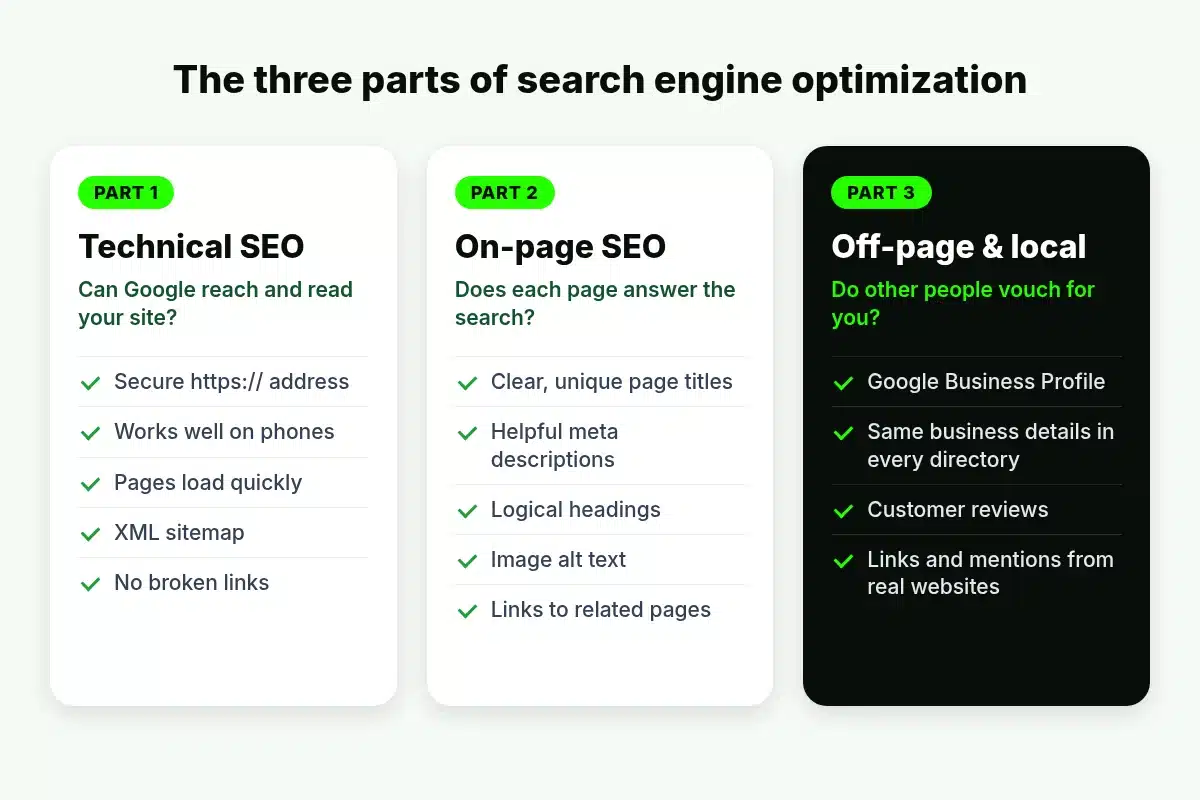
Technical SEO: can a search engine read your site?
This is the groundwork. First, your site needs a secure https:// address, pages that work well on phones, and pages that load quickly. Then an XML sitemap lists the pages you want found, and fixing broken links stops crawlers hitting dead ends. Without this layer, the rest of your SEO has nothing to build on.
On-page SEO: does each page answer the search?
Every page should have one clear job. For example, a page about bathroom remodels should say what you do, where you work and how to get a quote. So give it a unique title, a short meta description and logical headings. Then add descriptive alt text to images and link to related pages.
Regular blog posts help here too, because each one answers another question. Our guide to content marketing for small businesses shows how to plan them.
Off-page and local SEO: why would a search engine trust you?
By contrast, this part happens away from your website. Your Google Business Profile, directory listings and customer reviews all show Google that you’re a real, active business. Links and mentions from other real websites also help, such as a supplier or a local news story.
Above all, keep your details consistent. Your business name, address and phone number should match everywhere they appear.
A 30-minute search engine check you can do today
You don’t need special tools to spot the most common problems. Instead, work through this list in order:
- Search for site:yourdomain.com on Google. If your main pages appear, then Google has found and indexed them.
- Set up Google Search Console. It’s free, and it shows which searches bring people to your site and which pages Google can’t index.
- Open your site on your phone. Text should be readable without zooming, and buttons should be easy to tap.
- Look for https:// in the address bar. If it’s missing, you need an SSL certificate. Cyberduck Domains, a MagniTech sister company, sells SSL certificates and WordPress hosting.
- Read your page titles. Each page needs its own title that says what it offers, not just your business name.
- Search your business name. Check that your Google Business Profile shows the right hours, website and details.
If your details differ from one directory to the next, MagniTech’s listing management service keeps them accurate and consistent.
Shortcuts that break Google’s rules
Some old tricks now do more harm than good. Google’s spam policies name these, among others:
- Keyword stuffing: repeating a phrase, or a list of towns, until the text reads oddly.
- Hidden text: words that people can’t see, such as white text on a white background.
- Copied or mass-produced pages: content taken from other sites, or many near-identical pages made only to rank.
A simple test helps. In other words, if you’d feel awkward explaining a tactic to a customer, skip it. Write for the person searching first, because that’s what Google says its systems try to reward.
How long SEO takes and how to track it
SEO is slow by nature. Google’s SEO Starter Guide says some changes show up within hours, while others take months. It suggests waiting a few weeks before you judge a change.
Meanwhile, check a few numbers once a month:
- Clicks and searches in Google Search Console
- Calls, form fills and emails that come from your website
- Where your main pages appear for the searches that matter to you
Then compare month to month, since one good or bad week tells you very little. In short, SEO rewards steady work more than quick bursts.
Tip: SEO works best alongside your other marketing. To see how it fits with ads, social media and email, read our guide to what each online marketing channel does.
Want a second pair of eyes on your SEO?
Schedule a free consultation call, or email [email protected] if you prefer to write.
Frequently asked questions
What is included in MagniTech’s SEO plans?
All three monthly SEO plans (Starter, Growth and Pro) include on-page SEO, Google Business Profile optimization and posts, local citation management, backlinking and blog posts with internal links. As of October 2026, Starter costs $620 a month, Growth $1,320 and Pro $2,170.
How soon will I see results from MagniTech’s SEO?
MagniTech’s FAQ page says most businesses see noticeable improvements within 3 to 6 months. The timeline depends on your industry, your competition and the current state of your website. On the Growth and Pro plans, the first review meeting is after 3 months, with monthly meetings after that.
Can MagniTech fix my business listings?
Yes. The listing management service submits your business to online directories and keeps your address, phone number, hours and website consistent across them. Every SEO plan also includes local citation management with name, address and phone consistency checks. To get started, schedule a free consultation call or email [email protected].
People Also Ask
Can I do search engine optimization myself?
Yes, you can handle the basics of SEO yourself. Start with Google Search Console, clear page titles, a site that works on phones and a complete Google Business Profile. Many owners bring in help once the work outgrows the time they have.
What are the 4 types of SEO?
Guides usually list technical SEO, on-page SEO, off-page SEO and local SEO. First, technical work helps search engines read your site. Then on-page work makes each page answer a search. Off-page work builds trust through links and mentions, while local SEO helps you appear in nearby searches and on Google Maps. This guide groups off-page and local together.
Is SEO worth it for a small business?
For many small businesses it is. The visitors it brings are already searching for what you offer, and you don’t pay for each click. However, it takes months to build. If you need leads right away, paid ads can fill the gap while your SEO grows.